By:

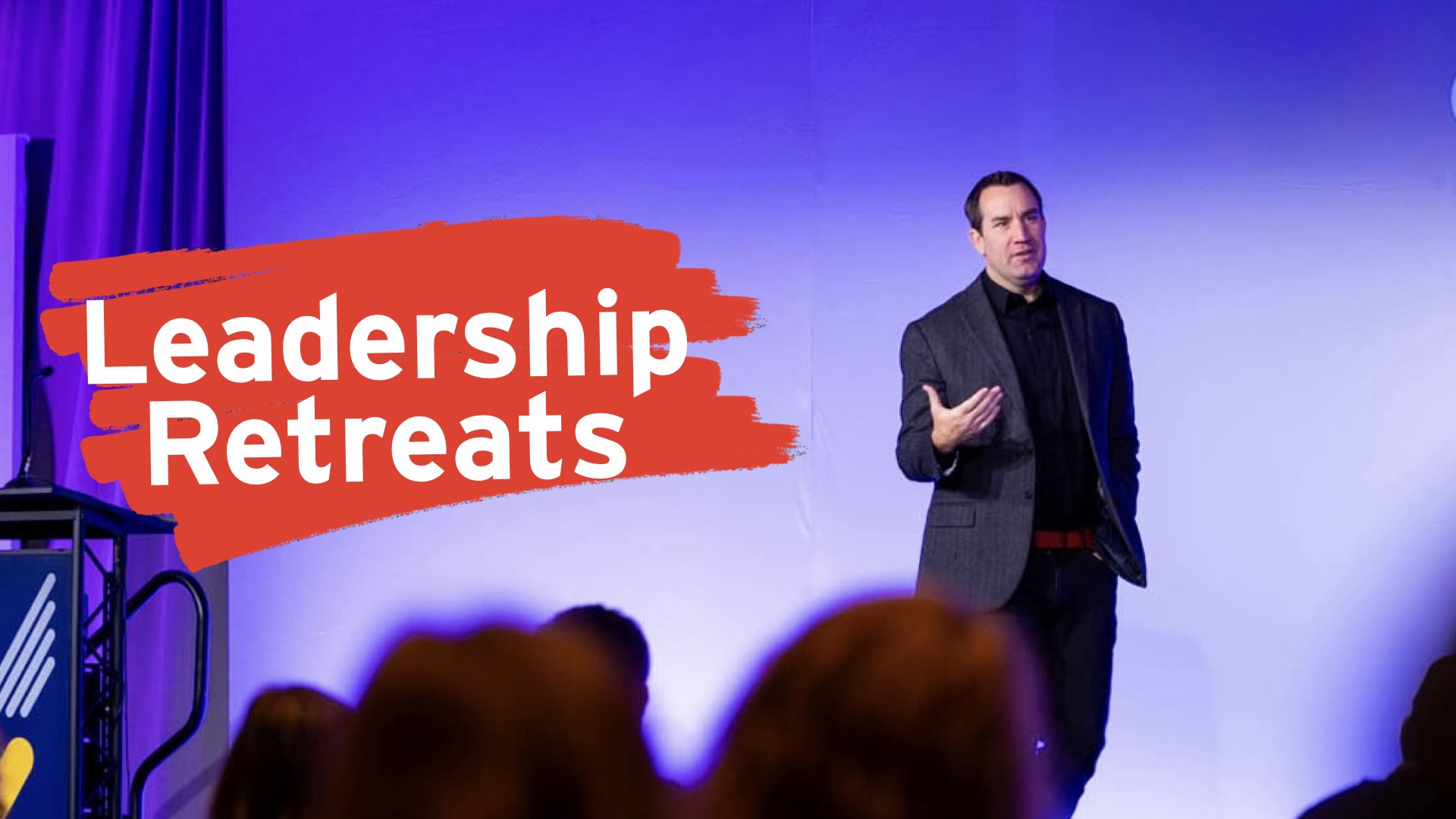
A leadership retreat can be one of the costliest meetings your organization will hold all year—and one of the most likely to underperform.
A survey from MIT Sloan found that only 34 percent of executive teams report strong alignment on strategic priorities after their annual leadership offsite. And that’s a huge missed opportunity, because research suggests that companies with aligned leadership teams are 2.5 times more likely to outperform their peers on revenue growth.
The gap between investment and impact is enormous—but it doesn’t have to be.
I’ve been the keynote speaker at hundreds of leadership retreats and executive offsites over the past decade. I’ve worked with C-suite teams of ten and leadership gatherings of 250 executives. I’ve seen retreats that became turning points—and offsites that became expensive PowerPoint marathons. The difference isn’t the venue, the budget, or even the agenda. It’s whether the leadership retreat is designed to strengthen trust and create genuine alignment, or simply to deliver information and check a box.
If you’re designing a leadership retreat—whether for your C-suite, your top 50, or your extended leadership team of hundreds—here’s what actually makes the difference.
Why Leadership Retreats Matter More Than Ever (And Why Most Underperform)
Let’s start with the stakes.
A leadership retreat pulls senior leaders out of daily operations—often for two or three full days. It requires travel budgets, production teams, venue contracts, catering, and weeks of preparation. For many companies, it’s the only time the entire leadership group is together in the same room.
Organizations are navigating rapid change, talent shortages, technological shifts, cultural transformation, and growing complexity. Senior leaders must move faster—and more cohesively—than ever before. A leadership offsite is one of the few moments when the entire leadership system pauses at the same time.
Done well, a leadership retreat creates momentum that lasts for quarters. Done poorly, it degrades into merely an expensive break from work.
Why? Because most leadership retreats fall into the same predictable traps:
Too much presentation, not enough conversation. Many offsites are structured like internal conferences. Leader after leader takes the stage. Updates are shared. Metrics are reviewed. Strategy decks are unveiled. Information is delivered—but alignment isn’t built. If your leadership retreat agenda is 70 percent presentations, you don’t have a retreat. You have a conference. And senior leaders don’t need more information. They need shared understanding.
Safe conversations instead of honest ones. In large leadership gatherings—especially those with 150 or more participants—power dynamics are real. Titles matter. History matters. Politics matter. Without intentional design, discussions stay polite. Disagreements stay underground. Tensions remain unspoken. But strategy doesn’t fail because leaders lack intelligence. It fails because leaders lack enough trust to surface the real friction.
Inspiration without integration. It’s not hard to create energy in a room of senior leaders. Good storytelling, compelling data, and a strong message can generate momentum. But momentum without application fades quickly. If leaders leave your executive retreat inspired but unclear about what changes Monday morning, the energy dissipates within 30–60 days. The organization returns to familiar patterns. Inspiration is easy. Integration is hard. And integration is what matters.
Start With Outcomes, Not Agendas
When I talk with those designing a leadership retreat, I always start with the same question:
What must be different 90 days after this retreat?
Not “What do you want leaders to learn?” Not “What topics need to be covered?” Not “Who needs to present?”
What must actually change?
Are there cross-functional tensions that need resolution? Is there confusion about strategic priorities? Are leaders aligned in words but not in action? Is trust strained after a difficult quarter or restructuring? Is there a cultural shift the organization needs to navigate?
When planners start with outcomes, the leadership retreat becomes focused and purposeful. When they start with agenda items, the event becomes crowded and reactive.
Clarity about desired outcomes shapes everything else—discussion design, speaker selection, session length, breakout formats, and follow-through plans. Without that clarity, you’re optimizing for attendance instead of impact.
Design for the Room You Actually Have
There’s a significant difference between facilitating a 12-person executive retreat and designing a leadership offsite for 150–200 leaders.
In larger leadership retreats, a few dynamics are almost guaranteed:
- Some voices dominate
- Some leaders disengage
- Middle layers hesitate to challenge senior voices
- Cross-functional misunderstandings linger quietly
Research from Amy Edmondson shows that psychological safety—the ability to speak up without fear of punishment or embarrassment—is the single strongest predictor of team performance. But psychological safety doesn’t emerge automatically in a ballroom with 200 people. It requires intentional structure.
Designing for senior leaders requires more than icebreakers and roundtable discussions. It requires structure that:
- Creates equal participation across levels
- Encourages cross-functional interaction
- Allows difficult issues to surface constructively
- Respects the intelligence and time constraints of executives
An executive offsite should feel substantive—not superficial. Senior leaders don’t want games. They want clarity. They want alignment. And they want confidence that their time away from the business is worthwhile.
The Hidden Pattern That Makes (Or Breaks) Leadership Retreats
If there’s one lesson, I’ve learned from speaking at leadership retreats across industries, it’s this:
Alignment is a byproduct of trust.
You can present the clearest strategy deck in the world. You can outline OKRs and quarterly goals with precision. But if leaders don’t trust one another enough to challenge assumptions, admit uncertainty, and ask for help, misalignment will persist.
This is where my framework, The Trust Loop, becomes critical. The Trust Loop describes how psychological safety is built and maintained in teams through three interconnected behaviors:
- Trust — One person develops a willingness to be vulnerable with another
- Leap — That person takes an interpersonal risk by speaking up
- Respect — The receiver demonstrates they respect the risk that was just taken
When this cycle repeats, psychological safety compounds. When the loop breaks—when respect isn’t shown—trust erodes.
A leadership retreat is often the best opportunity all year to reset relational dynamics and activate The Trust Loop across the leadership team. But this doesn’t happen through plenary sessions alone. It happens when the offsite creates space for cross-functional small groups where peers can debate without hierarchy, structured prompts that encourage vulnerability, and transparent discussion of trade-offs and constraints—not just polished success stories.
High-performing leadership teams assume positive intent, debate ideas without attacking people, surface risks early, follow through on commitments, and hold one another accountable respectfully. These behaviors don’t emerge automatically in a ballroom. They emerge when the retreat is intentionally designed to reinforce psychological safety and shared responsibility.
The Right Role for Keynote Speakers in a Leadership Retreat
One of the most common mistakes I see is treating outside keynote speakers as entertainment or inspiration.
The “parachute keynote” model—where someone delivers 60 minutes of energy and disappears—can be memorable. But it rarely creates sustained change.
In my experience working with organizations, the most effective leadership retreats use external voices as catalysts, not distractions.
That’s why I often recommend a format I call a “key-shop”—a blend of keynote and workshop. Instead of a traditional 60-minute talk, a 90 to 120-minute session combines a high-energy keynote to create shared language and urgency, structured small-group discussion to apply ideas to real organizational challenges, and clear prompts that tie directly to the company’s strategic priorities.
This format does three important things. It keeps energy high. It creates immediate relevance. And it ensures ideas are translated into action while leaders are still in the room together.
When external speakers reinforce the goals of the leadership retreat—rather than distract from them—they amplify the event’s impact. This approach turns a speaker from a moment into a force multiplier.
Build Space for Application and Alignment
In multi-day leadership retreats—whether 1.5 days or three full days—the rhythm matters.
Successful retreats typically balance plenary sessions for alignment and vision, small-group discussion for processing and debate, cross-functional interaction to break down silos, and decision-making blocks that produce clear commitments. Too much large-room content leads to passivity. Too much unstructured discussion leads to drift. Intentional structure keeps leaders focused while giving them space to wrestle with real issues. When leaders can see that the conversations are producing clarity, commitments, and direction, engagement stays high.
When I’ve seen leadership retreats produce lasting results, it’s because leaders leave with clear shared priorities—not just themes, but specific focus areas. They leave with a deeper understanding of one another’s pressures and constraints. They leave with specific behavioral commitments about what will change Monday morning. And they leave with agreed-upon follow-up mechanisms for how they’ll stay aligned.
Without those elements, the retreat becomes an isolated event rather than a catalyst for change.
Don’t Ignore What Happens After the Leadership Retreat
Most of the value of a leadership retreat is won—or lost—after the event ends.
Here’s where many organizations stumble: no shared summary of commitments, no reinforcement of key language or frameworks, no visible accountability, and no structured follow-up conversation. Within weeks, daily pressures take over. The shared language fades. The commitments get deprioritized. The momentum dissipates.
Organizations that treat the leadership offsite as a milestone—not a standalone moment—see dramatically different outcomes.
That can include revisiting commitments in monthly leadership meetings, cascading key themes throughout the broader organization, reinforcing shared language in performance reviews and internal communications, measuring progress on the priorities defined at the retreat, and scheduling a 90-day check-in to assess what’s changed and what hasn’t.
A leadership retreat should create a before-and-after effect. If nothing changes behaviorally within 90 days, it’s worth asking why.
A Practical Checklist for Planning Your Leadership Retreat
If you’re designing an upcoming leadership retreat, here’s a practical checklist to ensure your event drives real impact.
Before The Retreat:
☐ Define the desired outcome: What must be different 90 days after this retreat?
☐ Identify the tensions: What cross-functional friction, strategic confusion, or trust gaps need to be addressed?
☐ Design for the room size: How will you create equal participation and psychological safety with 150+ leaders?
☐ Balance the agenda: Is your ratio of plenary vs. small-group discussion appropriate? (Aim for 40% plenary, 60% application)
☐ Choose speakers strategically: Will external voices reinforce your outcomes, or will they distract from them?
☐ Prepare discussion prompts: What specific questions will surface honest dialogue and move beyond safe conversations?
During The Retreat:
☐ Create shared language: Introduce 1-2 frameworks that leaders can use to discuss challenges together
☐ Surface tensions constructively: Use structured prompts to bring underground issues into the open
☐ Document commitments visibly: Capture behavioral commitments and priorities in real time
☐ End with clarity: Ensure every leader leaves knowing what changes Monday morning
After The Retreat:
☐ Share a summary within 48 hours: Reinforce key themes, commitments, and next steps
☐ Cascade the language: Ensure the frameworks and priorities reach the broader organization
☐ Build accountability: Reference retreat commitments in monthly leadership meetings
☐ Schedule a 90-day check-in: Assess what’s changed, what hasn’t, and why
A Leadership Retreat Is an Intervention, Not an Event
When I look back at the most successful leadership retreats I’ve been part of, they share one characteristic:
They were designed to change how leaders work together—not just what leaders know.
They strengthened trust through The Trust Loop—trust, leap, and respect. They clarified priorities through structured discussion, not just polished presentations. They surfaced tension constructively through psychological safety. They created shared ownership through transparent dialogue.
And they did so with intention.
For the ones planning the leadership offsite, the responsibility is significant. They’re not just coordinating logistics. They’re shaping a moment that can influence culture, execution, and alignment for the year ahead.
A leadership retreat is one of the few times when your entire leadership system pauses together. That’s a rare opportunity.
Handled thoughtfully, it can become a turning point. Handled casually, it becomes an expensive line item.
If you’re planning an upcoming leadership retreat or executive offsite and want it to genuinely strengthen how your leaders collaborate, align, and execute—design it as an intervention, not an event.
Your organization will feel the difference long after everyone returns home.

About the author
David Burkus is an organizational psychologist, keynote speaker, and bestselling author of five books on leadership and teamwork.