By:

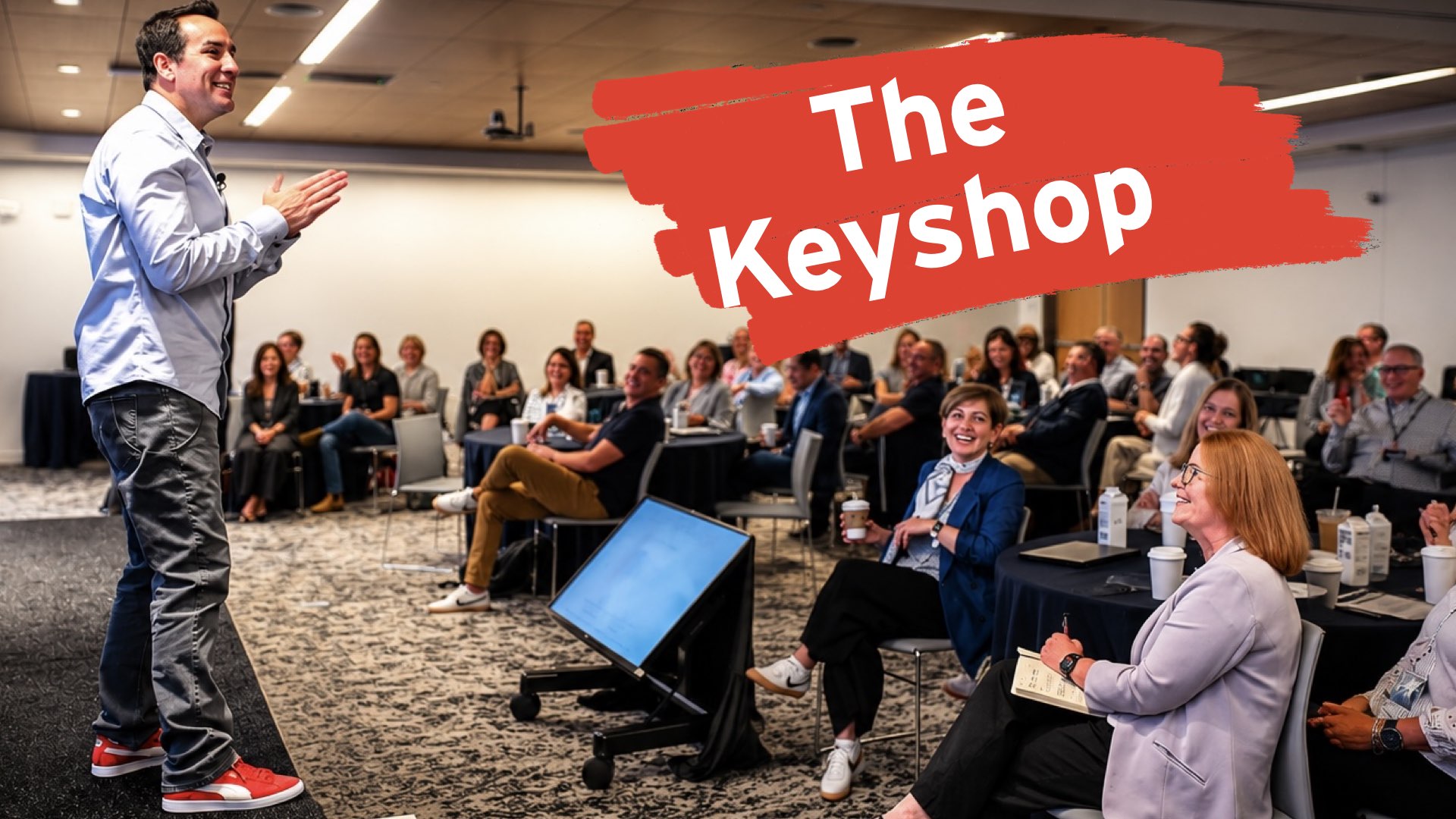
You’ve decided a keyshop is the right format for your event. Good call. Now comes the part nobody warns you about: a keyshop isn’t just a keynote with discussion questions stapled to the end. It requires a different kind of planning, a different kind of speaker, and a different kind of room setup than a standard session. Get those elements right, and a keyshop delivers something a traditional keynote simply can’t. Get them wrong, and you end up with an awkward hybrid that satisfies nobody.
This guide covers everything you need to know to plan and run a keyshop successfully—from booking the right speaker to designing the room to managing the rhythm on the day of the event.
Start With A Clear Outcome—Not A Topic
Every good event session starts with an outcome, but this is especially true for a keyshop. Because the format integrates discussion, the audience is going to do more than receive content—they’re going to apply it in real time. Which means you need to know, in advance, what you want them to apply it to.
A topic isn’t enough. Leadership” is a topic. “Trust” is a topic. An outcome sounds like this: “We want our leaders to leave with a shared understanding of why trust breaks down on cross-functional teams—and one concrete commitment for what they’ll do differently.”
That specificity matters because it shapes everything downstream. The speaker uses it to design the presentation segments and the discussion prompts. You use it to evaluate whether the session succeeded. And the audience benefits from a session that feels purposeful rather than generic.
Before you contact a speaker, write down your outcome in one or two sentences. If you can’t, that’s a signal you need more internal alignment before you’re ready to book.
Book A Speaker Who Can Actually Do This
This is the most important decision you’ll make, and it’s more nuanced than booking a standard keynote.
Not every great keynote speaker is a great keyshop speaker. The format requires two distinct skills that don’t always come packaged together: the ability to deliver high-energy, narrative-driven content to a large room, and the ability to facilitate—to transition smoothly between presenting and discussion mode, read the energy of the room in real time, and synthesize what surfaces in small-group conversation back into the forward momentum of the session.
When evaluating speakers for a keyshop, ask these questions directly:
Have you delivered this format before? Ask for specific examples—event names, audience sizes, what the discussion prompts were. A speaker who has genuinely delivered keyshops will be able to describe the experience in detail. A speaker who is retrofitting “interactive” onto their standard keynote will be vague.
How do you design the discussion prompts? This is the heart of the keyshop. The prompts need to be specific enough to generate useful conversation and open-ended enough to allow genuine reflection. A great keyshop speaker designs the prompts as carefully as the presentation content—because the discussion segments are where the real application happens.
How do you handle the transition between presentation and discussion? The rhythm of the keyshop—present, discuss, present, discuss—lives or dies on these transitions. Ask the speaker to walk you through how they manage them. Do they signal the shift clearly? Do they give groups a specific prompt or just say “discuss”? Do they bring the room back together effectively after each discussion round?
Will you customize to our context? The discussion prompts are only as useful as they are relevant to your audience’s actual challenges. A speaker who inserts your company name into a generic prompt isn’t customizing. A speaker who interviews your senior leaders before the event and builds the prompts around the real problems your organization is navigating—that’s customization.
Design The Room For Discussion
Room setup is where many keyshops quietly fail before the session even begins. A theater-style room—rows of chairs facing a stage—is designed for one-directional content delivery. It is the wrong setup for a keyshop.
Use rounds. Tables of six to eight people create natural discussion groups. They signal to attendees from the moment they walk in that this session will require participation, not just attention. They make it easy for the speaker to transition between presentation and discussion without moving furniture or disrupting flow.
Assign seats strategically. Left to their own devices, people sit with their own teams—the people they already know and already agree with. For most organizations, the most valuable keyshop conversations happen between people who don’t regularly work together. Research from MIT’s Human Dynamics Laboratory found that the most important predictor of a team’s success was its communication patterns—and that those patterns depend heavily on who is talking to whom.” Mix functions, regions, and levels intentionally. The cross-functional perspective that surfaces in a well-mixed table often produces the most useful insights.
Check sightlines carefully. In a round-table setup, some seats will have their backs to the screen or the speaker. Work with your AV team to position screens so that every seat in the room has a clear view. Nothing kills discussion momentum faster than attendees craning their necks to see a slide.
Consider the microphone setup. If the speaker will be synthesizing discussion back to the full room—which the best keyshop speakers do—they need to be mobile. A podium microphone won’t work. A lavalier or handheld allows the speaker to move through the room, which both enables better facilitation and sustains the energy between discussion rounds.
Brief The Speaker Thoroughly
A keyshop requires more pre-event preparation from the speaker than a standard keynote—and more from you as the planner. The pre-event briefing is where a generic session becomes a useful one.
At minimum, the speaker needs to know:
The specific challenge your organization is navigating. Not the official talking points—the real tension. What’s keeping your senior leaders up at night? Where is the team struggling to collaborate? What’s the conversation nobody is having openly? The more honest you are here, the more relevant the discussion prompts can be.
Who will be in the room. Audience composition shapes everything. A keyshop for 150 frontline managers requires different prompts than one for 200 senior leaders. A mixed-function audience needs different framing than a single-department group.
What has already been said. If your CEO opened the event with a strategic message, if there’s been a significant reorg, if a previous session introduced a framework the audience is already discussing—the keyshop speaker needs to know. The best keyshops build on the conversation already happening in the room, not alongside it.
Any sensitivities. Every organization has topics that require care. Layoffs, leadership transitions, competitive pressures, cultural tensions. Flagging these upfront lets the speaker navigate them deliberately rather than stumble into them accidentally during a discussion prompt.
Schedule a substantive call—not just an email exchange—with the speaker at least two to three weeks before the event. The speakers who take this call seriously and ask probing questions are the ones who will deliver a session worth the investment.
Manage The Rhythm On The Day
On the day of the event, your main job is to protect the keyshop’s rhythm. That means a few specific things:
Guard the time slot. Keyshops are scheduled for 90 to 120 minutes for a reason. The alternating cycles of presentation and discussion need room to breathe. If the session before yours runs long and eats into the keyshop slot, you don’t just lose time—you lose cycles. A 90-minute keyshop compressed into 60 minutes becomes an awkward keynote with one rushed discussion that the speaker has to cut short. Push back hard to protect the full time slot.
Start on time. This sounds obvious, but it matters more for a keyshop than a standard keynote. The opening presentation segment sets the energy and credibility that carries the first discussion round. A late, distracted start undermines both.
Brief the AV team on the format. Your AV crew needs to know that this isn’t a standard keynote. The speaker will be moving through the room. Slides will pause during discussion rounds. There may be moments of intentional silence while groups talk. An AV team that’s used to managing a linear presentation can inadvertently disrupt a keyshop by following the wrong cues.
Have a plan for discussion energy. Occasionally, a discussion round will land flat—groups stare at each other, the conversation doesn’t ignite. A good keyshop speaker will handle this in the moment, but you can reduce the risk by seeding each table with at least one person who is likely to be an engaged participant. Your most vocal leaders, your connectors, your people who are never short of opinions—distribute them intentionally around the room.
Close With Commitment, Not Just Conversation
The final discussion round of a keyshop should do something specific: generate commitments. Not insights. Not observations. Commitments.
Work with your speaker in advance to design the closing prompt around a concrete behavioral question. Something like: “What’s one thing you’ll do differently in the next 30 days based on what we’ve discussed today?” And then build in a mechanism for those commitments to be recorded—written on a card, entered into a shared document, shared with a partner at the table.
The keyshop’s greatest advantage over a traditional keynote is that it generates application in real time. Don’t let that advantage dissipate the moment the session ends. The closing commitment round is what transforms a great conversation into a durable change.
If you’re planning an event and want to explore whether a keyshop is the right format for your audience, let’s talk. And if you want to understand the format in more depth before you book, start with What Is a Keyshop?
About the author
David Burkus is an organizational psychologist, keynote speaker, and bestselling author of five books on leadership and teamwork.