By:

For years, event planners kept asking me the same question—just in different ways.
“Can you make it more interactive?” “We want something between a keynote and a workshop.” “Is there a way to get the energy of a keynote but have people actually do something?”
They were describing a format they couldn’t name. They knew what they wanted—they just didn’t have a word for it.
So I gave them one: keyshop. I coined the term to describe a format I’d already been delivering for years—and the name stuck.
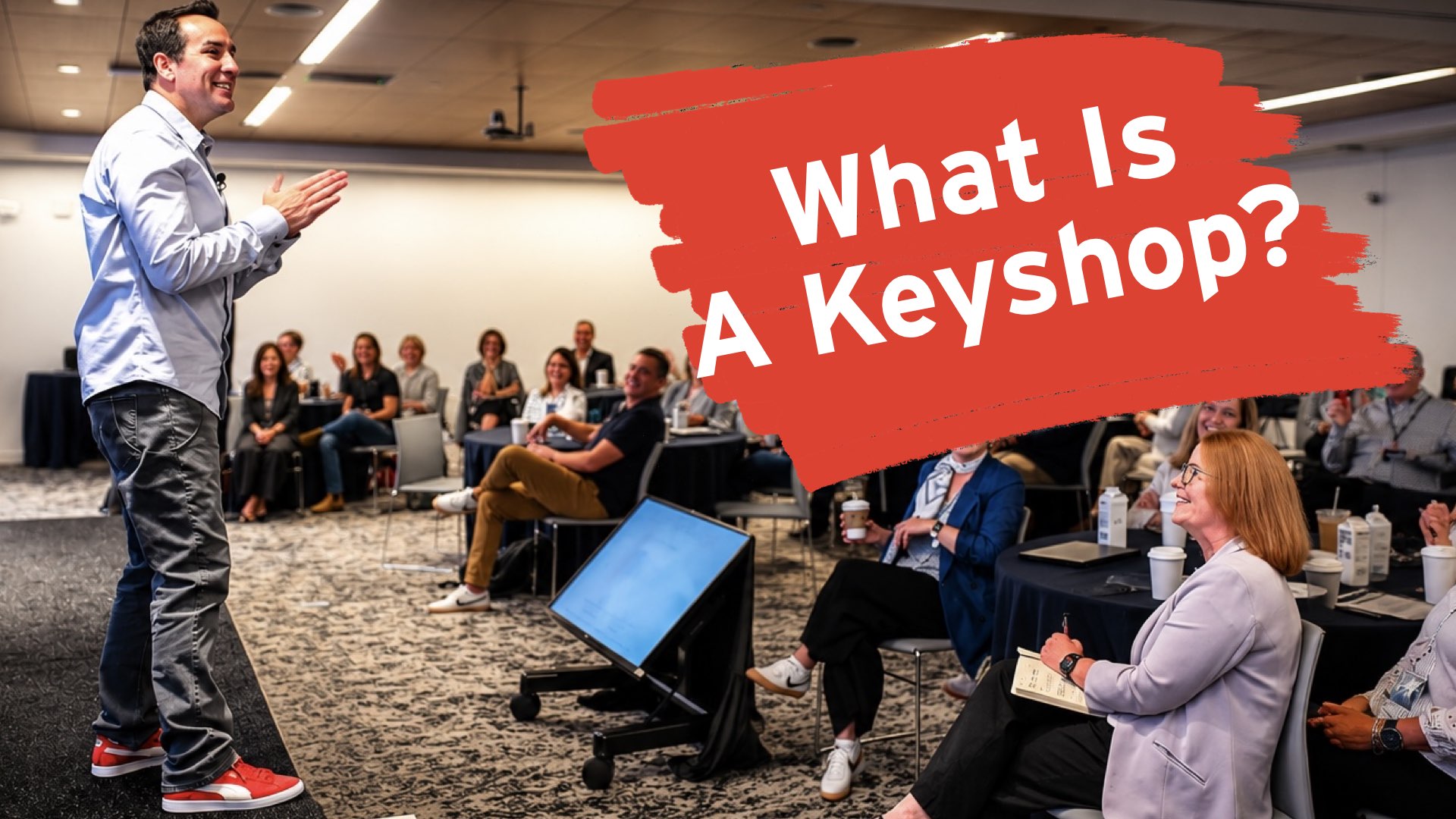
A keyshop is a hybrid format that combines the narrative energy of a keynote with the participatory depth of a workshop—not sequentially, but in an integrated rhythm. It’s not a keynote followed by a workshop. It’s not a workshop dressed up as a keynote. It’s something distinct: a 90- to 120-minute experience that alternates between high-energy presentation and structured small-group discussion in repeating cycles throughout the session.
The format has spread quickly. And for good reason—it solves a problem that has frustrated event planners and attendees for decades.
The Problem With Keynotes Alone
A great keynote is a remarkable thing. At its best, it creates a shared emotional experience, introduces a framework that changes how people think, and sends an audience out of the room differently than they walked in.
But keynotes have a fundamental limitation: they’re one-directional. The speaker delivers. The audience receives. And no matter how compelling the content, passive reception has limits.
Research on learning and retention is unambiguous here. People remember a fraction of what they hear. They remember significantly more when they discuss it, apply it, and teach it to someone else. A keynote—however brilliant—leaves the application work entirely to the audience, individually, after the event.
This is why so many organizations leave keynotes feeling inspired but unchanged. The insight landed. The application didn’t follow.
The Problem With Workshops Alone
Workshops solve the application problem. Small groups, structured activities, real-time practice—workshops create the kind of active engagement that keynotes can’t.
But workshops have their own limitation: they’re not designed for large rooms. The facilitation dynamics that make a workshop powerful for 20 people become unwieldy for 200. Energy is harder to sustain. Momentum is harder to build. And the narrative arc that makes ideas stick—the storytelling, the tension, the resolution—is largely absent.
Event planners who book a workshop for their 300-person leadership summit often find it falling flat. And the audience that came expecting energy and inspiration finds itself staring at a worksheet.
What a Keyshop Actually Is
A keyshop solves both problems by doing something neither format does alone: it integrates presentation and discussion into a single, rhythmic experience.
The structure isn’t “keynote, then discussion.” It’s a repeating cycle:
20–25 minutes of presentation. High-energy, narrative-driven content that introduces a concept, tells a story, and builds toward a key insight. The energy of the room is high. Everyone is engaged with the same material.
10–15 minutes of structured discussion. Specific, facilitated prompts that ask small groups to apply what they just heard to their own context. Not “what did you think about that?” but “where does this show up on your team right now? What’s one thing you’d do differently?”
Then the cycle repeats. Another segment of presentation. Another round of discussion. For 90 to 120 minutes total.
The effect is different from anything a pure keynote or pure workshop produces. The presentation segments create the shared conceptual framework and the emotional energy that makes ideas memorable. The discussion segments do something no keynote can: they translate the idea into the audience’s specific reality while they’re still in the room, with colleagues who are wrestling with the same challenges.
By the time the session ends, the audience hasn’t just heard something interesting. They’ve heard it, discussed it, applied it, and heard how their colleagues are thinking about it. That’s a fundamentally different level of processing—and a fundamentally different chance that something will actually change on Monday morning.
Why the Rhythm Matters
The interleaved rhythm—present, discuss, present, discuss—is what separates a keyshop from a keynote with Q&A or a workshop with a speaker opening.
Q&A is reactive. It responds to what the audience wants to ask, which is valuable but unpredictable. The keyshop discussion segments are proactive—specifically designed prompts that guide the audience toward application of the exact concept just presented.
A speaker opening followed by workshop activities is sequential. The energy peaks at the beginning and dissipates as the session moves into facilitated work. The keyshop rhythm maintains energy throughout, because the return to presentation after each discussion segment re-engages the full room before the next concept is introduced.
The rhythm also creates a different relationship between speaker and audience. In a keynote, the speaker is the sole source of insight. In a keyshop, the insights emerge from two sources: the speaker’s framework and the audience’s own experience applying it. That combination produces something neither could generate alone.
What a Keyshop Is Not
A few distinctions worth making clearly:
A keyshop is not a keynote with breakout sessions. Breakout sessions happen after the keynote ends, in separate rooms, often without the speaker present. A keyshop integrates discussion within the session, in the same room, with the speaker facilitating the transitions and synthesizing what emerges.
A keyshop is not a panel discussion. Panels involve multiple speakers sharing perspectives. A keyshop has a single speaker driving a coherent framework, with audience discussion woven into that framework.
A keyshop is not a workshop for large audiences. Traditional workshops are designed for small groups (typically under 50 people) and rely on intimate facilitation dynamics. A keyshop is designed to work for large audiences—100, 200, 300 people—while still creating genuine application and discussion.
A keyshop is not a “training.” Training implies skill acquisition through repetition. A keyshop is about shifting how people think and giving them a shared language for a challenge—not teaching a procedure.
When a Keyshop Is the Right Format
A keyshop isn’t the right choice for every event. It works best when:
The audience is large but application matters. If you’re running a 200-person leadership summit and you want people to leave with more than inspiration—if you need them to actually think differently about how they lead—a keyshop delivers what a keynote can’t.
The organization wants shared language. When the discussion prompts are tied to your organization’s specific challenges, the keyshop creates a common vocabulary that persists after the event. Leaders who went through the same experience, wrestled with the same prompts, and heard each other’s perspectives leave with genuine alignment—not just information.
Time is limited but depth matters. A full workshop requires half a day or more. A keyshop delivers meaningful depth in 90 to 120 minutes—making it practical for events where time slots are constrained but superficial content isn’t acceptable.
The goal is behavior change, not just inspiration. If the question is “will people do anything differently after this session?”—a keyshop dramatically increases the odds compared to a traditional keynote.
What to Look for in a Keyshop Speaker
Not every keynote speaker can deliver a keyshop. The format requires a different skill set.
A keyshop speaker needs to be able to present and facilitate—switching between the two modes fluidly, reading the room in real time, and synthesizing what surfaces in discussion back into the forward momentum of the session. That’s a different capability than pure keynote delivery, which is one person controlling a room’s attention in one direction.
The best keyshop speakers also design their content specifically for the format. The presentation segments need to end at natural application points—places where the audience’s own experience is directly relevant to what was just introduced. The discussion prompts need to be specific enough to generate useful conversation and open-ended enough to allow genuine reflection.
When evaluating whether a speaker can deliver a keyshop, ask for examples of sessions in this format—not just their standard keynote. Ask how they design the discussion prompts. Ask how they handle the facilitation of a large room. The answers will tell you quickly whether you’re talking to a keynote speaker who has added “interactive” to their marketing, or someone who has genuinely developed the keyshop as a distinct capability.
The Name, and Why It Matters
When I started describing this format to event planners, I needed a word. “Keynote-workshop hybrid” is accurate but unwieldy. “Interactive keynote” is vague—almost every speaker claims to be interactive. “Facilitated keynote” doesn’t capture the energy.
Keyshop captures both elements in a single, memorable word. It signals that this is not a choice between keynote and workshop—it’s a format that integrates both.
The format itself isn’t new. Speakers have been experimenting with ways to make keynotes more participatory for decades. What’s new is the name—and the explicit design philosophy that comes with it. When event planners can name what they want, they can ask for it clearly. When speakers understand the format distinctly, they can build content specifically for it. When organizations know what a keyshop is, they can decide deliberately whether it’s the right tool for their event.
That’s what naming things does. It makes the implicit explicit, and the accidental intentional.
If you’re planning an event and want to explore whether a keyshop is the right format for your audience, let’s talk. And if you want to go deeper on how to design and run a keyshop effectively, read How to Run a Keyshop: A Guide for Event Planners.
About the author
David Burkus is an organizational psychologist, keynote speaker, and bestselling author of five books on leadership and teamwork.