By:

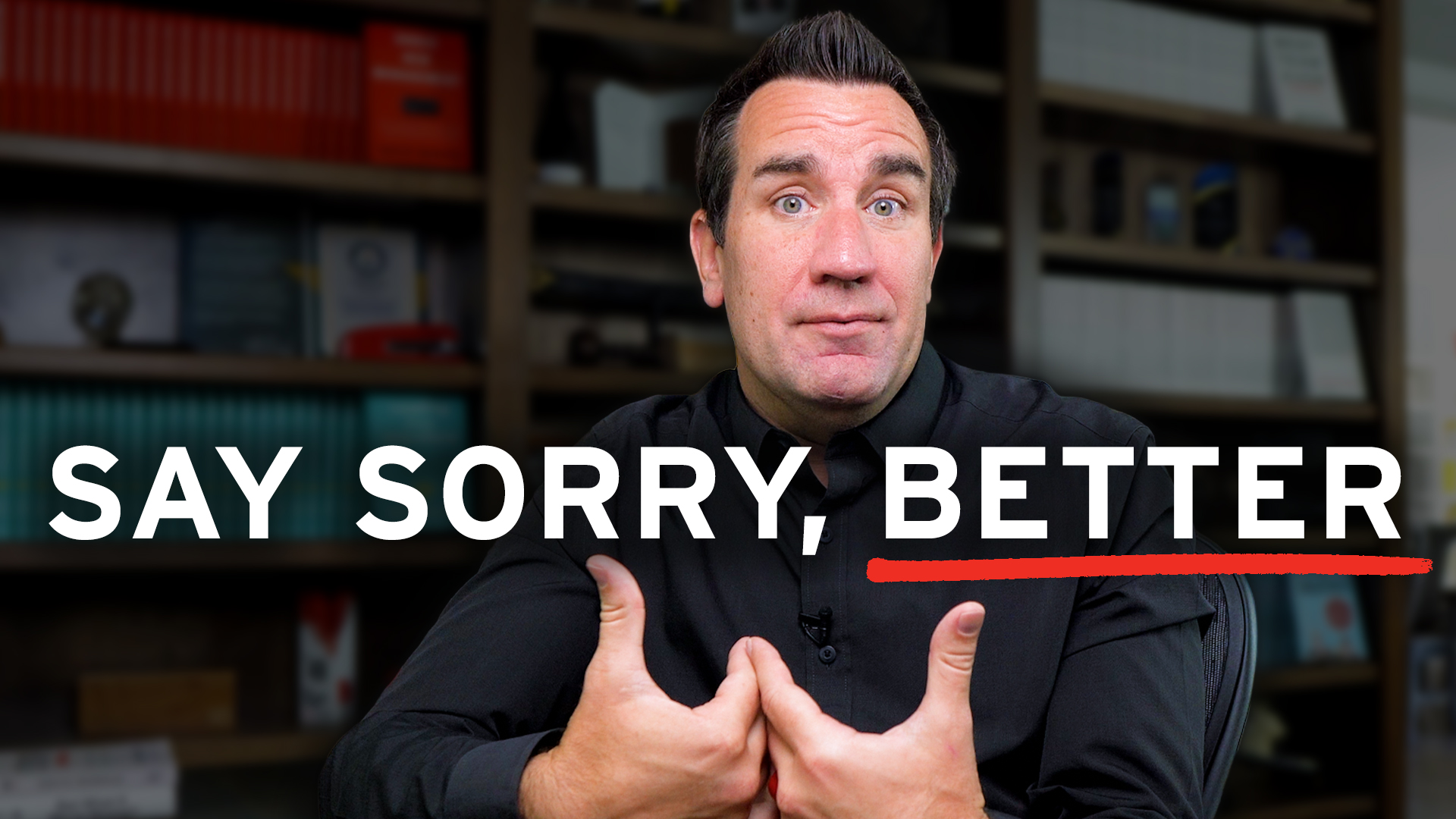
Nobody puts “professional apologizer” on a résumé. But if you lead people long enough, that’s a real part of the job—and learning how to apologize as a leader turns out to be one of the least-taught skills in management.
It also gets harder as you get more senior, not easier. The stakes get bigger. The audience gets larger. And the gap between how you think you’re doing and how your people think you’re doing widens considerably. One survey found that 49% of employees say their boss never or rarely apologizes, while nearly 60% of managers believe they always do. In the same survey, 71% of those managers admitted they avoid apologizing out of fear of looking incompetent—even though both groups agreed that acknowledging mistakes is among the most trust-building things a leader can do.
That’s the trap. The thing you’re avoiding to protect your credibility is the thing that would build it.
What follows are nine apologies you will almost certainly owe someone at some point in your career. They fall into three groups, and the group matters, because each one fails in a different way.
When you were wrong
The most obvious apologies are for the things you actually did.
The apology for making the wrong call
Every leader makes a bad one eventually—a strategy that didn’t pan out, a hire that didn’t work, a bet that looked smart right up until it didn’t. In theory this apology is simple: you were wrong, so say so. In practice it’s rare, because admitting a bad call feels like admitting you’re bad at your job. It isn’t. It’s three steps: admit you got it wrong, name what specifically went wrong, and share what you’re doing differently. Notice what’s missing. No “but.” No context-setting that quietly becomes an excuse. When researchers analyzed what makes an apology land, the component that mattered most was a clear acknowledgment of responsibility. In 1962, after the Bay of Pigs, President Kennedy stood before the press and said victory has a thousand fathers while defeat is an orphan—then named himself the responsible officer of the government. His approval rating went up.
The apology for how you showed up
You can be completely right on the substance and still owe someone an apology for the delivery. You snapped. You cut someone off. You rolled your eyes at an idea in front of eleven people. This apology should be short—”I was sharp with you earlier, that wasn’t okay, and I’m sorry I let my frustration come out that way”—and it should not rehash whatever frustrated you, because that just converts the apology into a second helping of the offense. What’s at stake here is psychological safety: the sense that people can disagree with you or bring you bad news without paying for it. Get it wrong and nobody quits dramatically. They just stop telling you things.
The apology for breaking trust
You promised a promotion. You committed to a timeline. You said the reorg wouldn’t touch your team, and then it did. Research on the psychological contract—the unspoken commitments between leaders and employees—suggests the damage runs past disappointment; in one study of hospital nurses, the state of that contract tracked with engagement, distress, and how people actually performed. So, say the actual thing: I told you this would happen, it didn’t, and I know that changes how much you’ll trust what I say next time. What doesn’t belong in it: “sorry if you’re disappointed,” or any attempt to litigate how good your intentions were.
When you should have
Harder than apologizing for what you did is apologizing for what you didn’t.
The apology for waiting too long
You kept the wrong hire around. You avoided the conflict everyone could see coming. There’s a reason this happens so reliably. Organizational psychologist Barry Staw’s study with the best title in the field—”Knee-Deep in the Big Muddy”—found that once people commit to a course of action, they tend to pour more resources into it as it fails, and the effect was stronger when they were personally responsible for the bad outcome. So, we call it patience. We give it one more quarter. Meanwhile the team can see exactly what’s happening. This apology has to name the delay itself, not just the outcome, and it has to answer the obvious next question: what changes now.
The apology for not seeing what was happening
Telling your team to bring you problems is a good instinct and a bad hiding place. Noticing is your job—noticing burnout, noticing that a difficult person has turned genuinely toxic, noticing that your best performer has quietly stopped performing. When you miss it, regret isn’t enough. The apology has to arrive with a system attached: first questions in your 1:1s that are about the person rather than the project, post-mortems where feedback has somewhere to go. You’re not just apologizing for missing something. You’re removing whatever made it possible to miss.
The apology for not listening
The other side of that coin is when someone did come to you and nothing happened. They raised a concern and you moved to the next agenda item. They pitched something and you were already halfway to your next meeting. This one is sneaky because it never feels like a decision—it feels like being busy. But dismissed is dismissed, regardless of intent, and waving off one concern teaches a team not to bring you the next one. Acknowledge the pattern, not just the moment, then go back and actually engage with what they raised. A week late still counts.
When you’re responsible anyway
The last group is what separates managers from leaders: apologizing for things you didn’t do and still have to own.
The apology for someone else’s mistake
Your team missed the deadline, sent the bad email, upset the client. It’s still yours to answer for—and it has two audiences. To the person harmed, be specific: what broke, what you’re changing, when they’ll see the difference. Specificity is what makes it sound like ownership instead of damage control. To your team, the apology looks like discretion. Do not name the individual to save your own reputation. They already feel bad enough, and learning you handed them over won’t make them more careful. It’ll make them more anxious—and more likely to make the next mistake overcorrecting for this one.
The apology for a necessary decision
Layoffs. A reorg. Budget cuts. Decisions made above you that you now have to stand in front of. You’re not apologizing because the call was wrong; you might believe it was exactly right. You’re apologizing because it hurt people, and both things can be true. This is the one leaders botch most often, and always the same way: they distance themselves. This wasn’t my call. I fought it. It feels like honesty. It’s one of the fastest ways to lose a team’s confidence. The line to hold acknowledges the cost without either claiming the decision or hiding behind the org chart.
The apology for the organization
A customer was harmed. A product failed. Misconduct went unchecked. None of it is your doing, but you’re the one at the microphone—speaking, for once, to people who have never met you and don’t care about your title. Researchers studying corporate apologies after public scandals found that apologizing generally restores consumer support better than silence or deflection, but that not every apology earns it. The ones that work carry two signals: culpability (“we did this”) and reform (“here’s what changes”). Reform was weighted more heavily. People don’t just want fault admitted. They want evidence something was learned.
Preparing To Apologize As A Leader
Here’s what connects them. The apologies that work never explain their way out of the responsibility—they name it, they let it be as big as it is, and then they do something about it. The ones that fail almost always have a “but” hiding somewhere in the middle.
You don’t need to work on all nine. Pick the one you recognized while reading, the one you’ve been carrying around for a few weeks. Knowing how to apologize as a leader isn’t really a communication skill. It’s the willingness to be briefly uncomfortable so that someone else doesn’t have to keep being uncomfortable indefinitely.

About the author
David Burkus is an organizational psychologist, keynote speaker, and bestselling author of five books on leadership and teamwork.